

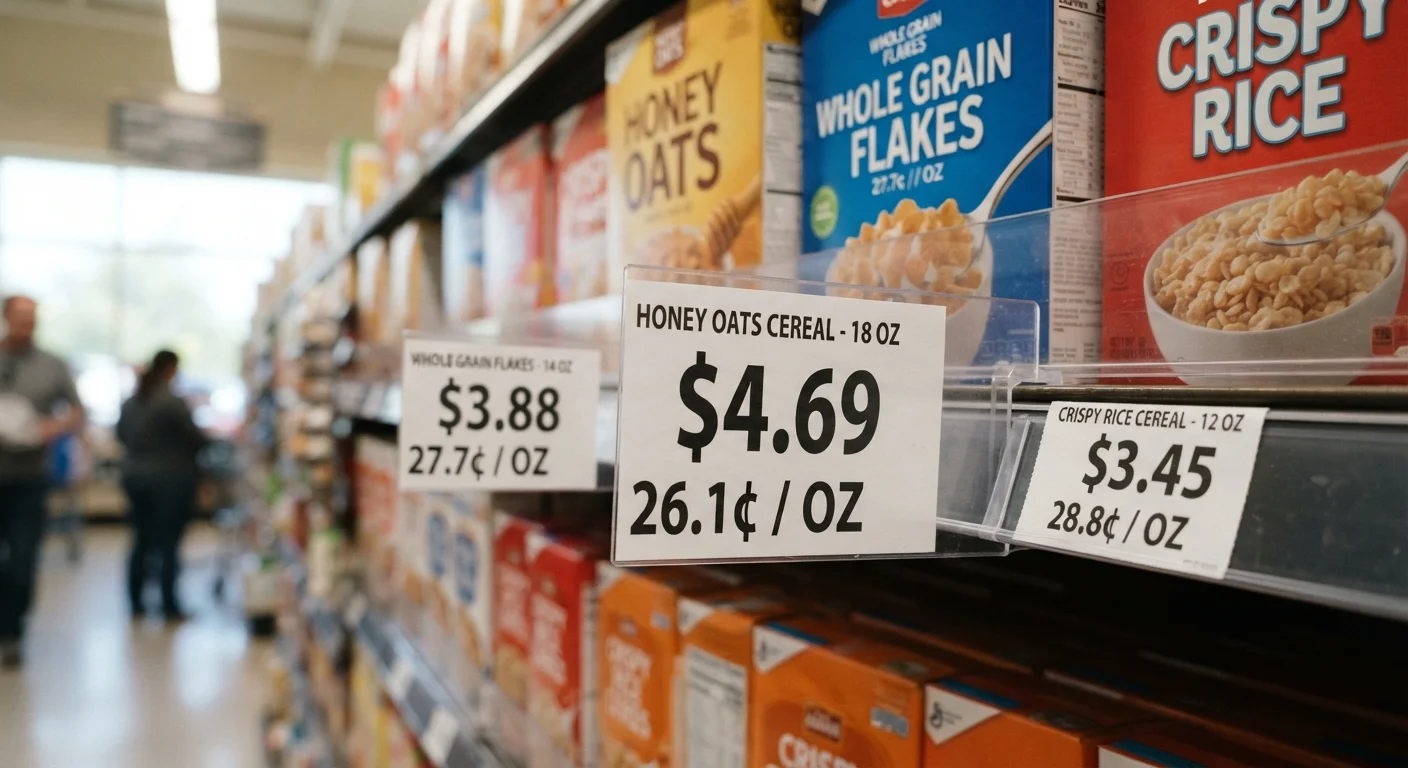
What a unit price actually tells you
The sticker price on a product tells you what you pay at the register. The unit price tells you what you pay for each ounce, sheet, tablet, or count inside the package. Those two numbers can point in completely different directions.
A 20-ounce jar priced at $3.00 has a unit price of 15 cents per ounce. A 30-ounce jar of the same product priced at $5.10 has a unit price of 17 cents per ounce. The larger package costs more per ounce despite its bigger size and higher sticker price. Without the unit price, that difference is invisible to most shoppers.
Unit prices are typically printed in small type on the shelf tag, often in a corner. They may appear as 'price per oz', 'per 100 ct', or 'per fl oz' depending on the product category. The unit has to be the same across items for a comparison to be valid.
Unit consistency matters before you compare
Two shelf tags must use the same unit to produce a valid comparison. Some stores display price per ounce for most items but switch to price per 100 count for items sold by piece. If the units differ, you cannot compare the numbers directly without a conversion step.
How to do the math yourself
When a shelf tag is missing or uses a different unit than the competing product, the calculation is straightforward: divide the total price by the total quantity.
- A 48-ounce detergent bottle priced at $7.68: $7.68 / 48 = $0.16 per ounce
- A 64-ounce version priced at $9.60: $9.60 / 64 = $0.15 per ounce
- A 100-count pack of vitamins at $12.00: $12.00 / 100 = $0.12 per tablet
A phone calculator handles this in a few seconds. The habit of dividing before you grab the shelf item is what separates a genuinely informed purchase from a guess.
When two tags use different units, convert first. To go from price per gram to price per ounce, multiply the per-gram figure by 28.35. To go from per milliliter to per fluid ounce, multiply by 29.57. These conversions rarely come up, but they do appear on imported goods or products in metric packaging.
A faster way to compare in-store
Open your phone's calculator and divide the total price by the ounce or count shown on the front of the package. You do not need the shelf tag to do this. Compare that result against the next size up or a competing product, and you have a reliable comparison in under 15 seconds.
Where unit pricing trips shoppers up
Several common situations make unit price comparisons harder than they should be.
Sale pricing: A sale on a smaller size can temporarily give it a lower unit price than the jumbo size. Once the sale ends, that relationship often reverses. Checking the regular shelf price alongside the promotional price gives a clearer picture of long-term value. Our article on costs hidden inside a sale price covers related traps in detail.
Multipack vs. single unit: A multipack of individually packaged snacks may list the unit price per package rather than per ounce. That makes it hard to compare directly against a bulk bag sold by weight. Always check which unit the tag is using.
Store brand comparisons: Store brands usually have lower unit prices, but not always. It is worth checking both; sometimes a name-brand size on promotion beats the store brand at regular price.
For a broader look at when larger quantities backfire, see why bulk buying is not always the cheaper choice and the trade-offs around bulk purchases.
30+
U.S. states with unit pricing regulations
According to the National Conference of State Legislatures, more than 30 states have laws or regulations governing unit price display, though requirements and product coverage vary.
Up to 30%
Potential per-unit savings from size comparison
Consumer research published by the Federal Trade Commission has found that unit price comparisons across sizes can reveal price-per-unit differences of up to 30% within the same product category.
Applying unit pricing beyond the grocery aisle
Unit pricing works on anything sold in variable quantities. Cleaning sprays, laundry pods, paper towels, shampoo, and pet food all carry unit prices in stores that display them. Online retailers frequently show unit prices in product listings, which makes comparisons across sizes easier even when products are not physically next to each other.
The details on reading shelf unit price labels covers what each part of a typical tag means. For purchases where you want to know whether a price is actually low relative to its history, price tracking tools add another layer of context.
Unit price math does not require a separate app or a shopping strategy overhaul. It requires one habit: before putting a product in the cart, check the per-unit figure and compare it to the nearest alternative size. That single check, done consistently, is where the real savings accumulate.
A shopper compares two sizes of peanut butter: a 16-oz jar at $3.20 and a 40-oz jar at $7.60.
A parent buys paper towels during a buy-two-get-one sale and checks the unit price on the shelf tag.
A household compares a name-brand cleaning spray at $4.50 for 32 oz against a store brand at $2.80 for 22 oz.
A shopper shopping online for vitamins sees a 60-count bottle at $9.00 and a 120-count bottle at $16.80.
Frequently Asked Questions
Unit prices are printed on the shelf tag directly below or beside the item. They appear in smaller type and show a price followed by a unit such as 'per oz' or 'per count'. If a tag is missing, you can calculate it yourself by dividing the total price by the number of units in the package.
You need to convert one unit to match the other before comparing. For example, if one product shows a price per gram and another shows per ounce, multiply the per-gram price by 28.35 to get its per-ounce equivalent. Most smartphones have a calculator built in, so this takes about ten seconds.
Yes. Unit pricing is common on cleaning products, paper goods, personal care items, and sometimes pet food. The same math applies: divide the total price by the quantity and compare across sizes or brands.
Not always. A lower unit price on a perishable item only saves money if you use all of it before it expires. Storage space, upfront cash, and household consumption rate all affect whether a lower unit price translates to real savings. See more in our article on <a href="/everyday-savings/why-buying-in-bulk-is-not-always-the-cheaper-choice">when bulk buying does not save money</a>.
Divide the total package price by the number of units (ounces, sheets, tablets, etc.) in that package. The result is the cost per unit. For example, a 32-ounce bottle priced at $4.00 works out to $0.125 per ounce, or 12.5 cents per ounce.
Yes. A sale price on one size can temporarily give it a lower unit price than a larger size that is not on sale. Once the sale ends, the relationship may reverse. It is worth noting the regular unit price alongside any promotional price so you can judge the long-term value.
The content provided on our blog site traverses numerous categories, offering readers valuable and practical information. Readers can use the editorial team’s research and data to gain more insights into their topics of interest. However, they are requested not to treat the articles as conclusive. The website team cannot be held responsible for differences in data or inaccuracies found across other platforms. Please also note that the site might also miss out on various schemes and offers available that the readers may find more beneficial than the ones we cover.