

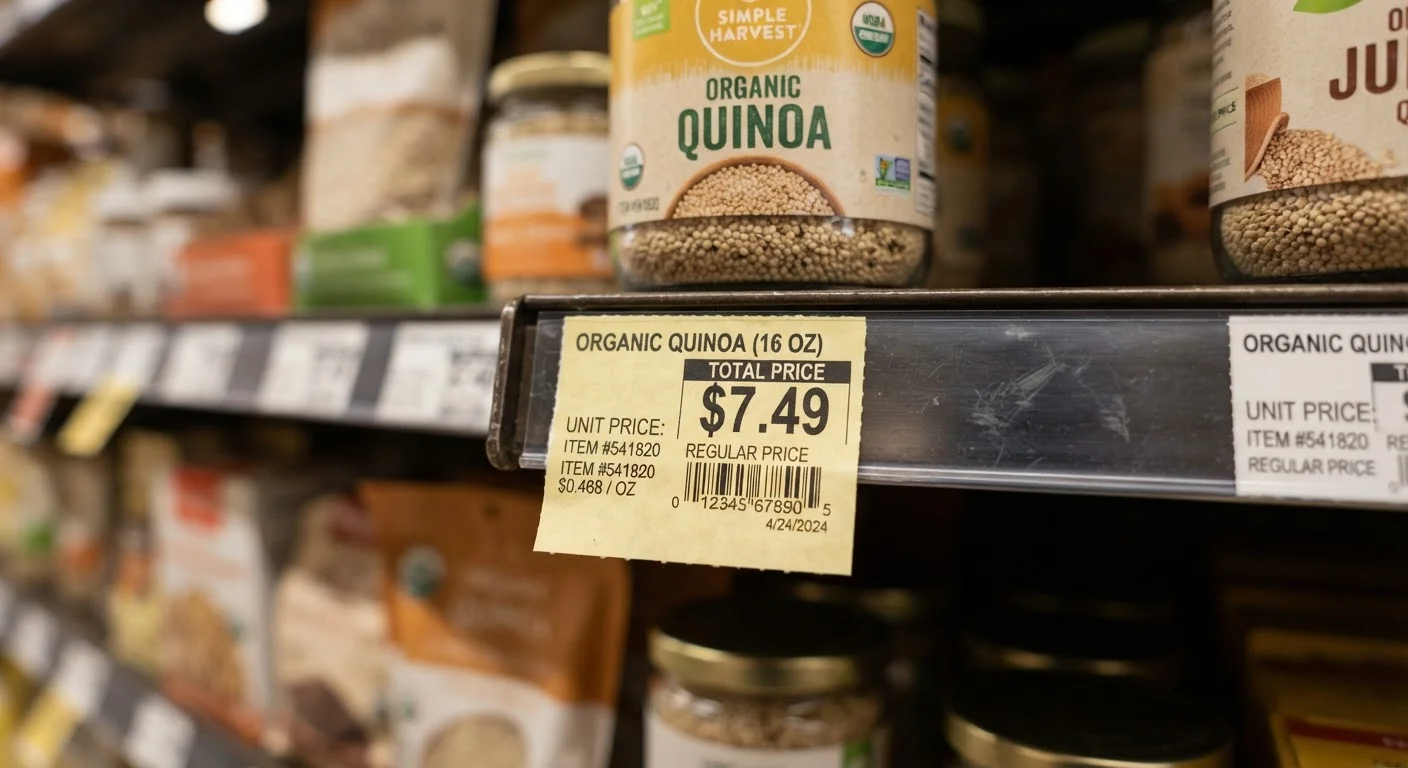
What that small number on the shelf tag actually means
Walk down any grocery aisle and you will see dozens of price tags. The large number is the total price of the package sitting on that shelf. The small number, often tucked below it, is the unit price: what you pay for each ounce, pound, count, or liter inside that package.
That small number is the useful one. Total prices tell you whether something fits in your wallet today. Unit prices tell you whether you are getting more or less product for your money compared with every other option on the same shelf.
The reason most shoppers skip it is simple: the big number is designed to be read, and the small number requires a moment of deliberate attention. Retailers are not hiding the unit price, but nothing about a shelf layout draws your eye to it. Once you know to look, finding it takes about two seconds.
For a deeper look at how to do the math quickly while shopping, see this walkthrough on reading unit prices.
Why size and sale price are not enough on their own
A common shopping instinct is to assume that a larger package costs less per unit. This is often true, but not always. Stores sometimes price mid-size packages at a lower unit cost than the jumbo version, particularly when they want to move that specific size. A sale sticker adds another layer of confusion: a 10% discount on a large package may still leave it more expensive per ounce than the regular-priced smaller version next to it.
~30
U.S. states with unit pricing laws for food retailers
Consumer advocacy organizations have tracked state-level unit pricing requirements, though coverage and enforcement vary considerably across jurisdictions.
Different for every product
Unit of measure used on shelf labels
Grocery shelf tags may show cost per ounce, per 100g, per count, or per fluid ounce depending on the product category and retailer, which is why comparing labels within the same product type matters.
Sale prices deserve the same unit-price check as any other item. Hidden costs inside a sale price can also erode what looks like a deal before you even reach the register. The unit price label does not account for spoilage, storage space, or cash outlay, so it is one input rather than a complete answer. Those trade-offs matter especially for perishables, which is a topic covered in detail at bulk buying: when it saves and when it costs more.
How to use unit pricing as a routine habit
The goal is not to scrutinize every single item every trip. A more practical approach is to apply unit pricing selectively, starting with the products your household buys every week: cooking oil, breakfast cereal, canned tomatoes, laundry detergent. For those staples, a one-time comparison across sizes and store brands can lock in a default choice that saves money passively on every future trip.
Build a short reference list
For the 10 to 15 items your family buys most often, note the best unit price you have found and the size it corresponds to. Keep the list in a notes app on your phone. You will not need to re-check those items each trip unless a sale tag or a new size appears on the shelf.
Unit pricing also makes store-brand comparisons easier. Because both the name brand and the store brand carry a unit price, you can compare them directly without estimating. The unit price strips away packaging and marketing and leaves only the cost of the actual product.
Over time, building this habit fits naturally into a broader approach to managing grocery spending. Setting category spending limits for groceries gives unit pricing a clearer purpose: you are not just choosing the lower number, you are making sure your regular choices stay within a range that works for your household.
For items where price changes week to week, price tracking tools can complement unit pricing by telling you whether today's unit price is actually low relative to recent history.
Frequently Asked Questions
It is usually printed in smaller type below the large total price, often in a box or after text like 'price per oz' or 'per unit.' Some stores place it in the upper left corner of the tag. If you cannot find it, look for a separate smaller label directly beneath the main price tag.
Many states require unit pricing at retail food stores, but the rules differ. Some states exempt smaller stores or certain product categories. If a store near you does not display unit prices, you can use the package weight and total price to calculate the cost per ounce yourself.
No. While bulk sizes often cost less per unit, this is not guaranteed. Retailers sometimes price smaller packages at a lower unit cost to move inventory, and sale prices on smaller sizes can temporarily flip the usual pattern. Always check the label rather than assuming.
Unit pricing works best when comparing the same product in different sizes or brands. Comparing across different product types is less useful because the measure may not be the same. For example, liquid and powder versions of a cleaning product may use different units on their labels.
Divide the total price by the number of units, ounces, or count listed on the package. For example, a 32-ounce bottle priced at $4.00 costs $0.125 per ounce. Most smartphone calculators handle this in a few seconds.
The content provided on our blog site traverses numerous categories, offering readers valuable and practical information. Readers can use the editorial team’s research and data to gain more insights into their topics of interest. However, they are requested not to treat the articles as conclusive. The website team cannot be held responsible for differences in data or inaccuracies found across other platforms. Please also note that the site might also miss out on various schemes and offers available that the readers may find more beneficial than the ones we cover.