

Our Verdict
Bulk buying produces genuine savings on non-perishables that a household uses at a predictable pace, with adequate storage space and cash flow to absorb the upfront cost. It works against families when the items spoil, expire, or go unused, or when the purchase strains a monthly budget that would otherwise stay balanced. The per-unit price is only part of the math.
Families with consistent consumption habits, a dedicated storage area, and a stable enough cash flow to pay a larger amount upfront without disrupting other budget categories.
How bulk pricing actually works
Warehouse clubs and big-box retailers build bulk pricing on a simple premise: you pay more upfront and they move more product per transaction. The retailer wins on volume; you win on price per unit, at least in theory. Whether that theory holds depends on two numbers most shoppers skip: the unit price and the realistic usage rate in your household.
The unit price label on the shelf edge shows cost per ounce, count, or sheet. Comparing that number across package sizes takes about ten seconds and tells you more than the bold total price on the front of the package. Some bulk packages carry a higher unit price than a standard size, particularly for name brands competing against store brands on the same shelf.
A membership fee also enters the equation for warehouse clubs. That annual cost, spread across every purchase made during the year, is a real expense that belongs in any honest comparison of what bulk shopping actually costs your family.
Where bulk buying delivers on its promise
Lower unit price on non-perishable staples
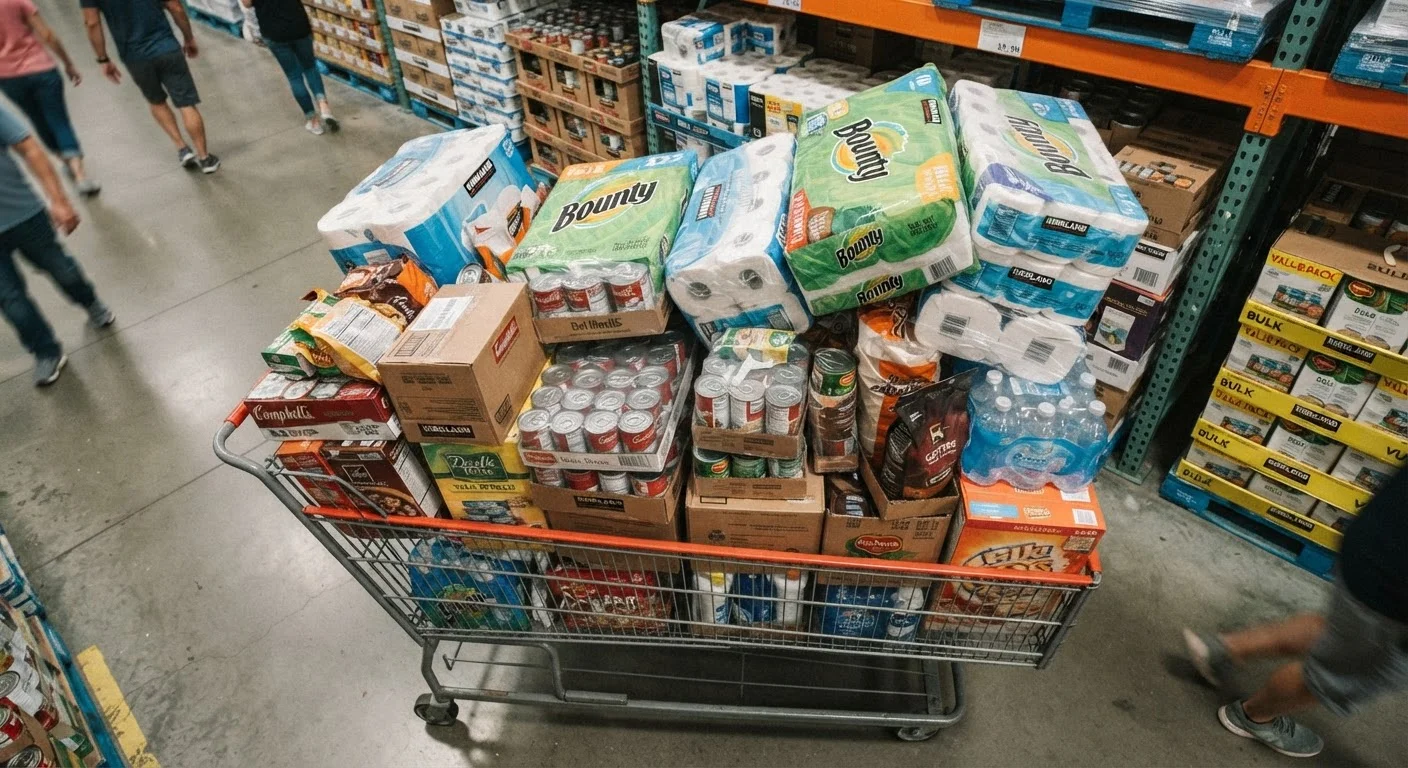
Buying paper goods, canned goods, and cleaning supplies in large quantities typically reduces the cost per unit. The savings are real as long as the unit price on the bulk package is verified against smaller sizes.
Fewer shopping trips for household staples
Stocking up on regularly used items means fewer separate purchases, which reduces both time spent shopping and the likelihood of impulse spending during extra store visits.
Predictable supply for high-use items
Families with children or specific dietary needs benefit from a steady on-hand supply of items that are consumed at a reliable weekly rate, reducing the risk of running out at an inconvenient time.
Works well for shared or split purchases
Two households splitting a large bulk pack each pay a lower effective price while reducing the storage burden on either household alone, making the arrangement practical even in smaller homes.
The strongest case for buying in bulk involves products that share three traits: non-perishable, used at a steady pace, and storable without dedicated equipment. Paper towels, toilet paper, dish soap, laundry detergent, canned beans, and dried pasta all qualify. A family that goes through one bottle of dish soap every three weeks will absolutely use a six-pack before any quality concern arises.
Bulk purchases also reduce shopping frequency for staples, which matters because each trip to the store carries its own cost in time, fuel, and the risk of unplanned purchases. Planned grocery trips consistently cost less than unplanned ones, and buying staples in bulk supports that discipline by keeping the pantry stocked between planned trips.
For households with children, bulk buying on snacks, school supplies, and hygiene items can align well with predictable consumption. The key word is predictable. If a child reliably eats one brand of granola bar every school day, buying a large box makes sense. If preferences shift monthly, a large quantity becomes a gamble.
When bulk buying quietly costs more
Spoilage erases per-unit savings on perishables
Fresh produce, dairy, and bread bought in bulk routinely go bad before a household finishes them, turning the per-unit discount into a net financial loss once wasted food is counted.
Large upfront outlay strains tight monthly budgets
Spending significantly more in a single shopping trip can crowd out other budget categories, even when the purchase is sensible over a longer time horizon. Cash flow timing matters as much as unit economics.
Storage space has real, often unpriced costs
Extra shelving, a second refrigerator, or a rented storage unit all add ongoing expense. These costs often appear on a different bill than the original purchase, making them easy to overlook.
Locks in a product that may fall out of use
Preferences change, products are reformulated, and household composition shifts. A two-year supply of an item locks you in at a time when flexibility may have more value than the per-unit discount.
Membership fees reduce the effective savings
Annual warehouse club fees are a fixed cost that must be spread across all purchases made through that membership. Families who shop there infrequently may not recoup the fee through discounts.
Produce, dairy, bread, and most prepared foods spoil faster than a large package can be consumed by a typical family. Buying a three-pound tub of mixed greens to save forty cents per ounce means nothing if half of it goes into the compost bin by Thursday. Spoilage converts a per-unit discount into a net loss.
Perishable waste is the most common bulk buying mistake, but it is not the only one. Product turnover matters too. Buying two years' worth of a cleaning product locks you into that product if you switch brands, react to an ingredient, or find a better alternative. The money is already spent and the product takes up shelf space.
Storage space has a cost that most households do not price explicitly. A secondary refrigerator running continuously to hold bulk perishables adds to the monthly electricity bill. Rented storage adds even more. These overhead costs erode the per-unit savings and in some cases flip the math entirely. Small recurring costs like these are easy to overlook because they appear on a different bill than the original purchase.
Cash flow is a separate concern. Spending a large sum on bulk goods in a single week can crowd out other budget categories even when the purchase is rational over time. A family operating on a tight monthly budget may be better served by buying smaller quantities at a slightly higher unit price, keeping more cash available for immediate needs.
A practical framework for deciding
Three questions before buying in bulk
Ask whether the item will be fully consumed before it expires, whether the bulk unit price actually beats the standard size, and whether the upfront spend leaves your monthly budget intact. All three need a clear yes before bulk buying makes financial sense. Uncertainty on any one of them is a signal to buy a smaller quantity.
Before committing to any bulk purchase, three questions clarify the decision without requiring spreadsheet work. First: will this item be fully used before it expires or degrades? Second: does the unit price on the bulk package actually beat the unit price on the standard size? Third: does spending this amount now leave the monthly budget intact for other necessary purchases?
If all three answers are yes, bulk buying is likely the right call. If any answer is no or uncertain, a standard package is usually the lower-risk choice. This framework applies equally to warehouse club purchases and to large packs found at conventional grocery stores.
One useful habit is tracking how long a standard package of a given item lasts in your household. A bottle of olive oil that takes four months to finish tells you that a three-bottle pack will sit in a cabinet for close to a year, which is relevant for both quality and storage planning. That same tracking reveals which items your family actually uses fast enough to justify bulk quantities.
For a broader look at where hidden costs appear in purchases that seem straightforward, sale price math applies many of the same principles to discounted items. The category covered in generic versus name brand comparisons also overlaps here, since the unit price advantage of bulk sometimes disappears when a store-brand standard size is available.
The content provided on our blog site traverses numerous categories, offering readers valuable and practical information. Readers can use the editorial team’s research and data to gain more insights into their topics of interest. However, they are requested not to treat the articles as conclusive. The website team cannot be held responsible for differences in data or inaccuracies found across other platforms. Please also note that the site might also miss out on various schemes and offers available that the readers may find more beneficial than the ones we cover.