

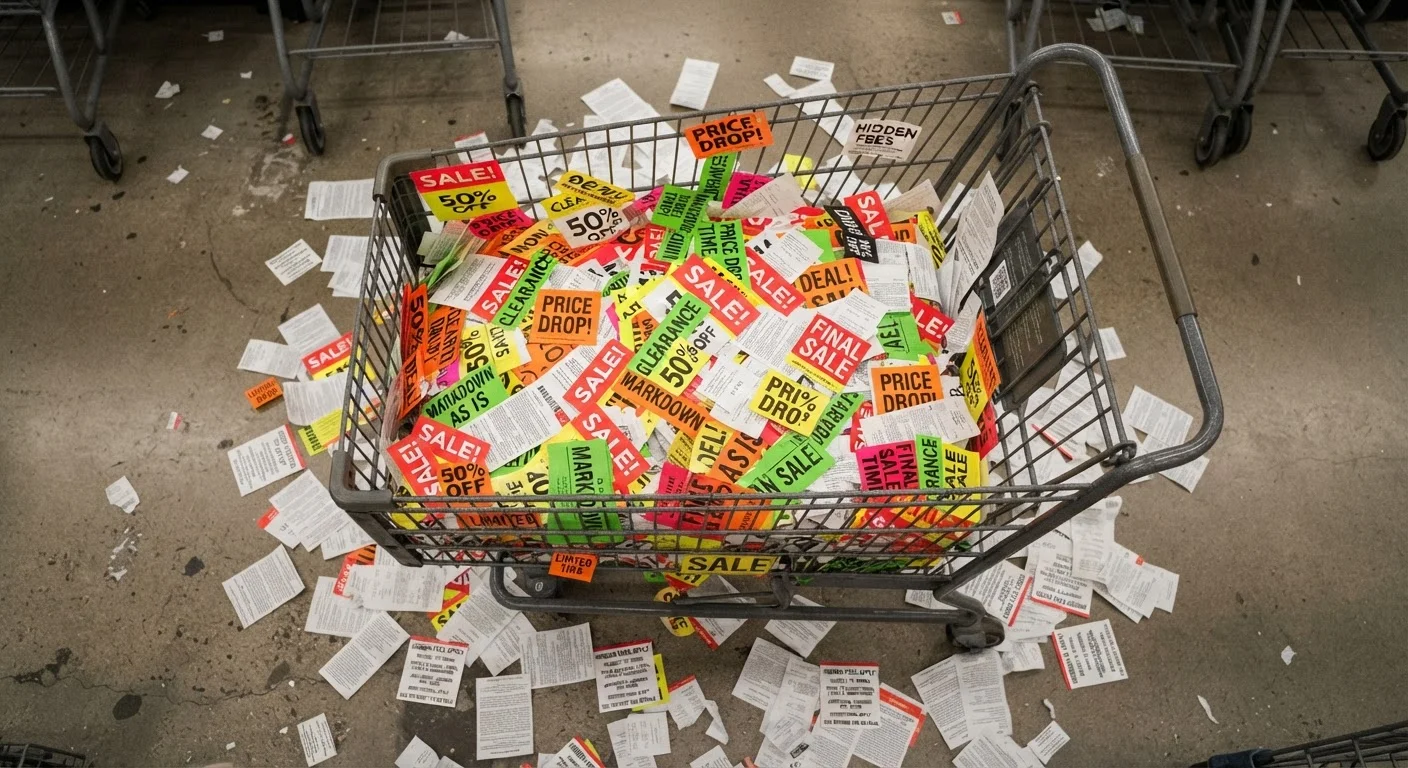
Why sale prices mislead more often than shoppers expect
A price tag showing 30% off feels like a straightforward win. The problem is that the number doing the most work in that equation, the 'original' price, is the one least likely to be verified. Retailers set their own reference prices, and in some product categories it is standard practice to briefly list a higher price before a promotional period begins. The result is a markdown that looks generous but reflects little or no real reduction from what the item normally costs.
This is not a niche issue. Price inflation ahead of sale events has been documented across consumer electronics, apparel, and home goods. Sale season myths around events like Black Friday follow this pattern consistently. The fix is simple in theory: stop anchoring on the crossed-out price and start comparing against verified historical data.
The discount percentage is not your savings
A 40% discount means nothing without knowing the price before the sale window opened. If the original price was inflated in the weeks prior, the 'sale' price may be no lower than the item's typical retail price. Always compare against a longer price history, not just the crossed-out number on the product page.
The fees that appear after you commit
Shipping costs, handling charges, and return fees are the most reliable way for a good-looking deal to shrink at checkout. A $40 item discounted from $60 looks like a $20 saving. Add $12 shipping and a possible 20% restocking fee if the item does not work out, and the math changes entirely.
Restocking fees are particularly worth watching in electronics and large appliances, where they can run from 15% to 25% of the purchase price. The pre-purchase checklist approach, where you confirm total cost and return terms before confirming any order, handles most of this risk before money changes hands.
For families buying tech, the fee exposure does not stop at checkout. Accessories, setup costs, and ongoing subscription charges can dwarf the device price. Hidden tech costs compound the problem when a discounted device still requires expensive add-ons to function as expected.
Trusting the crossed-out 'original' price as a reliable baseline.
Why it happens: Retailers are not always required to prove the reference price reflects a real prior selling price, so shoppers assume the comparison is honest.
Calculating savings from the item price alone, ignoring shipping and handling fees.
Why it happens: The headline discount is front and center, while fees appear only at checkout, making them easy to overlook until the total surprises you.
Overlooking restocking fees buried in the return policy.
Why it happens: Most shoppers read the return window but skip the fee structure, assuming returns are free unless stated otherwise.
Buying more than needed because a 'per unit' deal looks attractive.
Why it happens: Bundle and multipack sales create the impression that buying more is always smarter, especially when the per-unit price drops noticeably.
Ignoring whether a sale price is actually lower than the item's normal price.
Why it happens: Shoppers anchor on the percentage off rather than checking whether the absolute price is genuinely reduced compared to typical market pricing.
Skipping the fine print on sale exclusions, coupon restrictions, and cash-back terms.
Why it happens: The savings methods that work together on paper sometimes have overlapping exclusions that cancel each other out, and shoppers discover this only at checkout.
Building a habit that catches these problems before you pay
The most practical defense is a short pre-checkout routine. Before confirming any purchase on a sale item, check the total with all fees included, look up the item's price history on at least one external source, and read the return policy for the word 'restocking.' Three steps, two minutes.
For grocery and household goods, unit price labels give a fast, accurate comparison across package sizes so a sale on a larger size does not mask a worse per-unit price. The same logic applies to bulk purchases: bulk buying trade-offs are worth running through before committing to a large quantity just because the unit price dropped.
None of this requires extra time if the steps become routine. The goal is to make the final checkout total the number you evaluate, not the headline percentage.
The content provided on our blog site traverses numerous categories, offering readers valuable and practical information. Readers can use the editorial team’s research and data to gain more insights into their topics of interest. However, they are requested not to treat the articles as conclusive. The website team cannot be held responsible for differences in data or inaccuracies found across other platforms. Please also note that the site might also miss out on various schemes and offers available that the readers may find more beneficial than the ones we cover.