

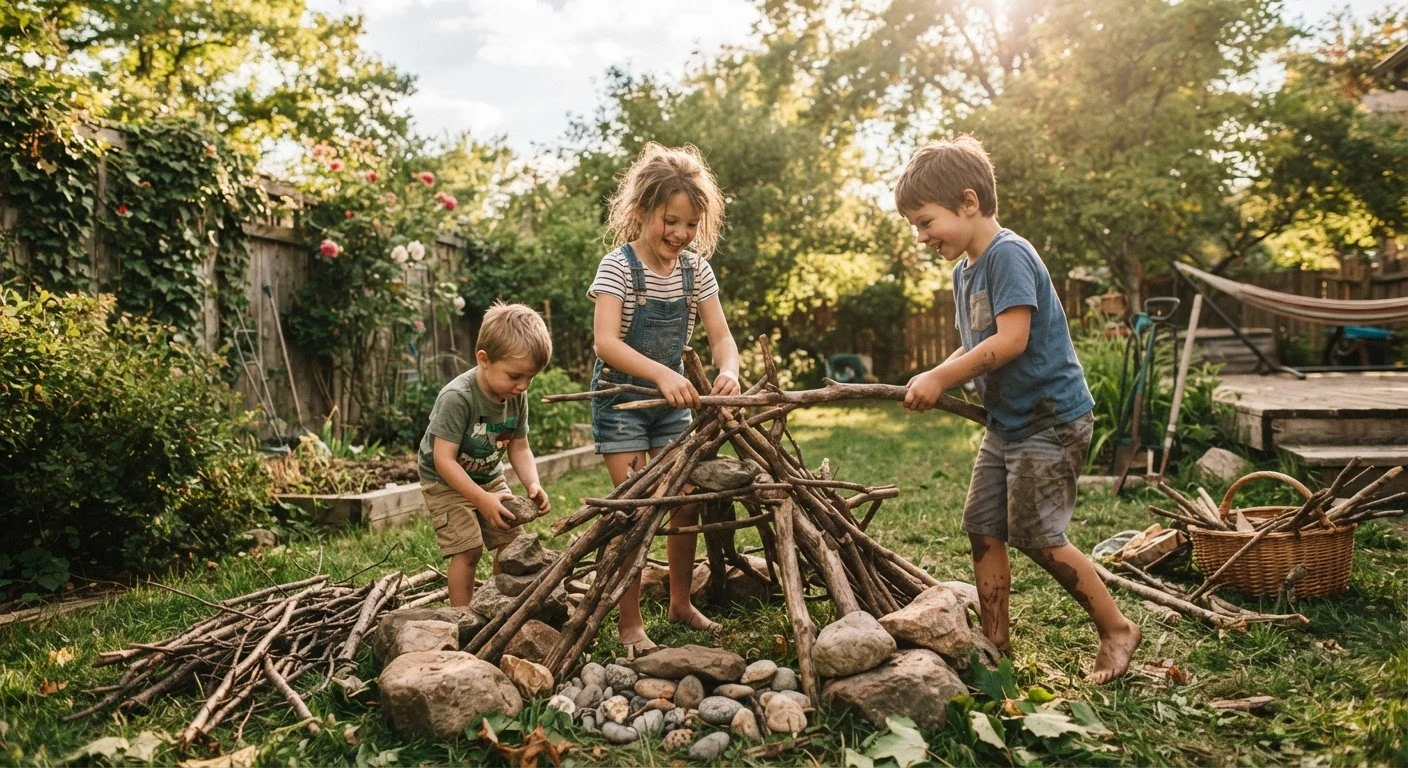
Why free play is worth protecting
Free play is unstructured time where children choose what to do, set their own rules, and follow their own curiosity without adult direction. It is different from organized sports, supervised crafts, or app-based games with preset objectives. Research from the American Academy of Pediatrics has linked this kind of child-directed play to stronger executive function, better emotional regulation, and more flexible social skills.
For families watching their budgets, free play has a practical advantage that often goes unmentioned: it costs nothing. No admission, no equipment purchase, no subscription. What it does ask for is time and a family culture that treats open-ended play as worth protecting, not filling.
Research on free activities and family stress suggests the benefits extend to parents too. When children are engaged in self-directed play, adults get a genuine mental break, which has real value for household wellbeing.
Practices that make free play a household habit
The families who manage this well tend to follow a set of consistent, low-effort practices rather than elaborate planning. The practices below can be adopted one at a time and adjusted to fit your home's space, schedule, and ages.
Designate a daily unstructured window with no planned activities.
Children need repeated exposure to open-ended time before they become comfortable filling it themselves. A consistent window, even 30 to 45 minutes, trains the expectation that this time belongs to them. Without a protected slot, free play tends to get crowded out by homework, errands, or screens.
Rotate a small set of open-ended materials rather than buying new toys.
Open-ended materials, such as cardboard boxes, fabric scraps, building blocks, or sand, support more varied play than single-purpose toys because children can assign them new meanings each time. Rotating materials in and out keeps them feeling new without any spending.
Take screens out of the play space, not just out of children's hands.
A television or tablet present in a room pulls attention even when it is off. Physically relocating screens to another room during play windows removes passive competition for children's attention and makes it easier for imaginative play to take hold.
Be present without being a director.
Children play more freely when a trusted adult is nearby but not managing the activity. This presence signals safety and availability without turning play into a performance. It also lets parents observe and connect without the cost of an organized outing.
Bring play outside whenever conditions allow.
Outdoor environments, including yards, sidewalks, parks, and open fields, offer more variable stimuli than any indoor space and require no equipment. Natural materials like dirt, water, leaves, and sticks expand creative play in ways manufactured toys often cannot match.
Quick actions you can take today
If the idea of reshaping your family's daily rhythm feels like a big project, start smaller. Each of these actions takes under ten minutes and creates immediate room for free play to happen.
For ideas on pairing free-play habits with planned outings, the free family day-out checklist walks through how to keep costs at zero while giving kids new environments to explore. And if you want seasonal inspiration, a full year of no-cost seasonal activities covers every region of the U.S.
Keeping it going without burning out
The hardest part of building any family habit is sustaining it past the first week. Free play routines tend to stick when they are tied to something that already happens: after dinner, before screen time, or as part of Saturday morning. Anchoring play to an existing moment in the day removes the need to schedule it separately.
Children also need some latitude to be bored before play ignites. A few minutes of "there's nothing to do" is normal and productive, not a problem to solve. Resisting the urge to suggest activities is one of the more counterintuitive parts of this, but it matters.
If your family wants to combine free-play culture with more outdoor exposure, overlooked outdoor recreation options lists places that rarely charge admission and give children genuine room to roam. Some 'free' activities carry hidden costs, so it helps to know what to check before you leave the house.
The content provided on our blog site traverses numerous categories, offering readers valuable and practical information. Readers can use the editorial team’s research and data to gain more insights into their topics of interest. However, they are requested not to treat the articles as conclusive. The website team cannot be held responsible for differences in data or inaccuracies found across other platforms. Please also note that the site might also miss out on various schemes and offers available that the readers may find more beneficial than the ones we cover.