

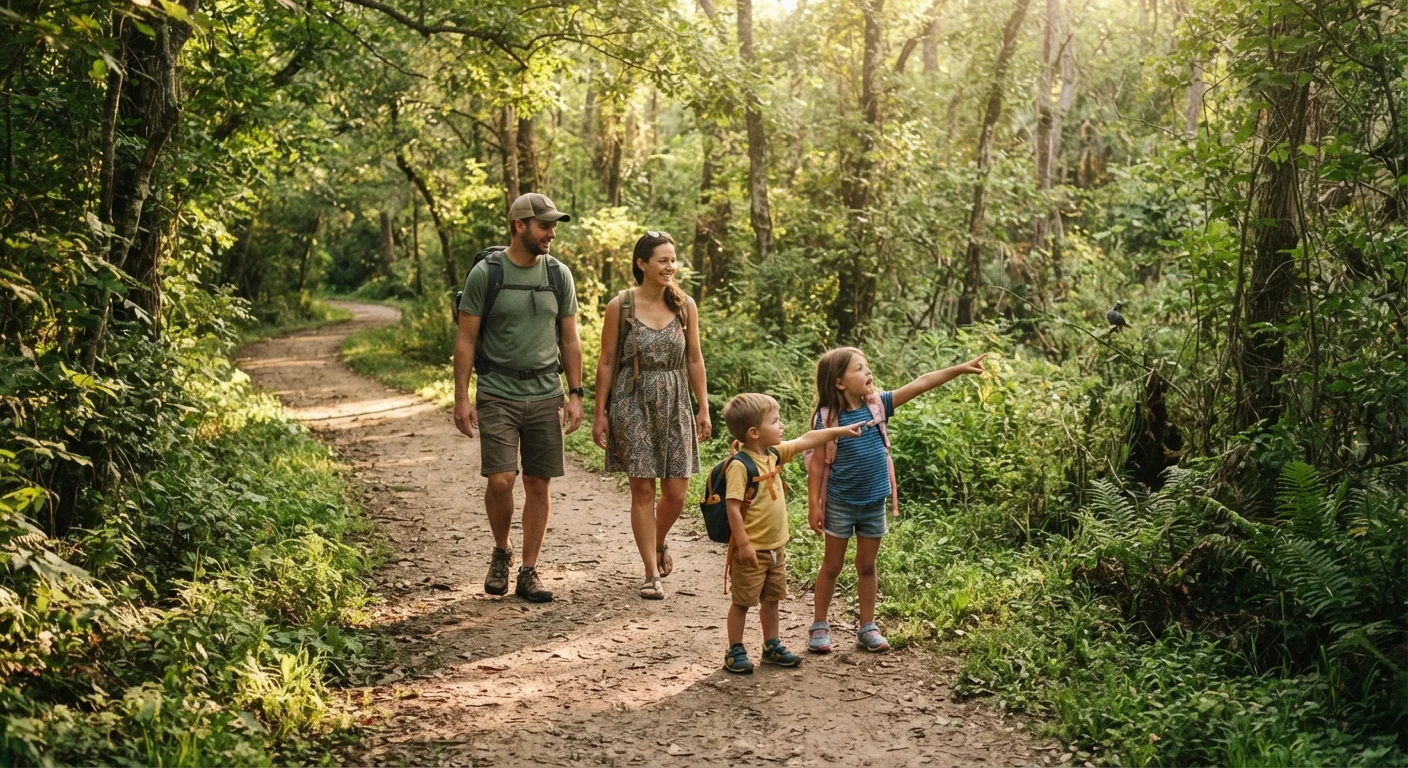
The free outdoor spots most families scroll past
National parks get the headlines, and state parks get a solid second look, but a long list of genuinely free outdoor destinations sits mostly untouched by family vacation planners. That gap is not about quality. It is about visibility. The places below draw less social-media traffic, which means shorter trails, emptier picnic tables, and kids who actually have room to run.
Before you pack the car, a quick note: even free sites sometimes charge for parking lots or specific amenity areas, and hours and programs can change seasonally. Always verify current details on the managing agency's official website. For a broader look at how free sites compare with paid ones, see our side-by-side guide to state parks and national parks.
National Wildlife Refuges
The US Fish and Wildlife Service manages more than 560 national wildlife refuges covering over 150 million acres. Most charge no entrance fee, and many have dedicated visitor centers, wildlife observation decks, and family-friendly loop trails. Refuges like Bombay Hook in Delaware, Bosque del Apache in New Mexico, and Chincoteague in Virginia draw migratory birds in numbers that genuinely stop kids mid-stride. The agency's website includes a refuge-finder tool that filters by state and available activities, making it easy to locate one within driving distance.
More than 560 refuges stretch across every state, and most charge no entrance fee.
Army Corps of Engineers lakes and recreation areas
The US Army Corps of Engineers manages roughly 12 million acres of land and water at more than 400 lakes nationwide. Day-use areas at these sites frequently include swimming beaches, boat ramps, picnic shelters, and hiking trails at no charge, though some developed campgrounds do have fees. Because Corps lakes are spread across interior states like Oklahoma, Arkansas, and Tennessee, they fill a real gap for families who live far from coastlines or mountain parks. Search the Corps' recreation gateway online to find sites near you and check which amenities are currently open.
Army Corps lakes at more than 400 locations often include free beaches and trails.
Urban trail networks and greenways
Most mid-sized and large American cities have connected trail systems that link parks, rivers, and neighborhoods in ways that map apps rarely surface prominently. The Atlanta BeltLine, the San Antonio River Walk's natural extensions, the Cleveland Metroparks Emerald Necklace, and dozens of similar networks are entirely free to walk or bike. These trails work especially well for families with strollers or kids on bikes, because the surfaces are typically paved or packed gravel with minimal elevation change. Local parks-and-recreation websites usually publish downloadable trail maps with distance markers and restroom locations.
City greenways and trail networks are free, paved, and built for families with younger kids.
Bureau of Land Management open space
The Bureau of Land Management (BLM) administers about 245 million acres of public land, concentrated in the western states. Unlike national parks, BLM land generally has no entry fee and no reservation requirement for day use. Families in states like Utah, Colorado, Nevada, and Wyoming can access slot canyons, desert arches, river corridors, and forested plateaus that rival anything inside a fee area. The BLM's website organizes sites by state and lists current conditions, which matters because some roads require high-clearance vehicles and some areas close seasonally for wildlife protection.
BLM land covers 245 million acres in the west with no entry fee for day use.
State forest recreational areas
State forests are distinct from state parks, and that distinction usually works in a budget-minded family's favor. Where a state park might charge a per-vehicle day-use fee, many state forests allow free access to hiking trails, fishing streams, and dispersed picnic areas. Pennsylvania, Michigan, and Oregon each manage millions of acres of state forest with extensive free trail systems. Because these forests exist primarily for timber management rather than tourism, signage and facilities are simpler, but the trails are real and the solitude is genuine. A call to the state's forestry division or a visit to its website will clarify which areas are free and whether seasonal permits apply.
State forests often allow free hiking and fishing where state parks charge day-use fees.
Flood-control channels and nature parks managed by water districts
Water districts across the country maintain open channels, retention basins, and riparian corridors that double as linear parks. The Santa Ana River Trail in Southern California, the Tres Rios Wetlands near Phoenix, and similar sites managed by flood-control or water-management authorities are free to the public and packed with wildlife. Tres Rios, for example, covers more than 700 acres with walking paths, bird blinds, and fishing piers maintained by the City of Phoenix at no admission charge. These sites rarely appear in family travel searches, which means they stay genuinely uncrowded on weekends.
Water-district parks like Tres Rios cover hundreds of acres with free trails and bird blinds.
Making the most of your visit
A little advance planning turns any of these spots from a pleasant walk into a full-day outing. Download trail maps before leaving home, since cell service is often spotty at refuges and reservoir shorelines. Pack water, snacks, and a basic first-aid kit regardless of how short the planned hike looks on paper.
Look up the managing agency first
Each category of public land has its own agency website with current conditions, trail closures, and program calendars. Bookmarking the US Fish and Wildlife Service, Army Corps of Engineers, and BLM recreation pages takes five minutes and saves real frustration on travel day. Many of these sites also list free ranger-led programs for kids that are not advertised anywhere else.
If your family wants even more ideas organized by season and region, our year-round free activity guide covers accessible, no-cost options across every part of the country. And if the word "free" ever comes with a hidden asterisk, this article on unexpected costs explains what to watch for before you plan.
The content provided on our blog site traverses numerous categories, offering readers valuable and practical information. Readers can use the editorial team’s research and data to gain more insights into their topics of interest. However, they are requested not to treat the articles as conclusive. The website team cannot be held responsible for differences in data or inaccuracies found across other platforms. Please also note that the site might also miss out on various schemes and offers available that the readers may find more beneficial than the ones we cover.