

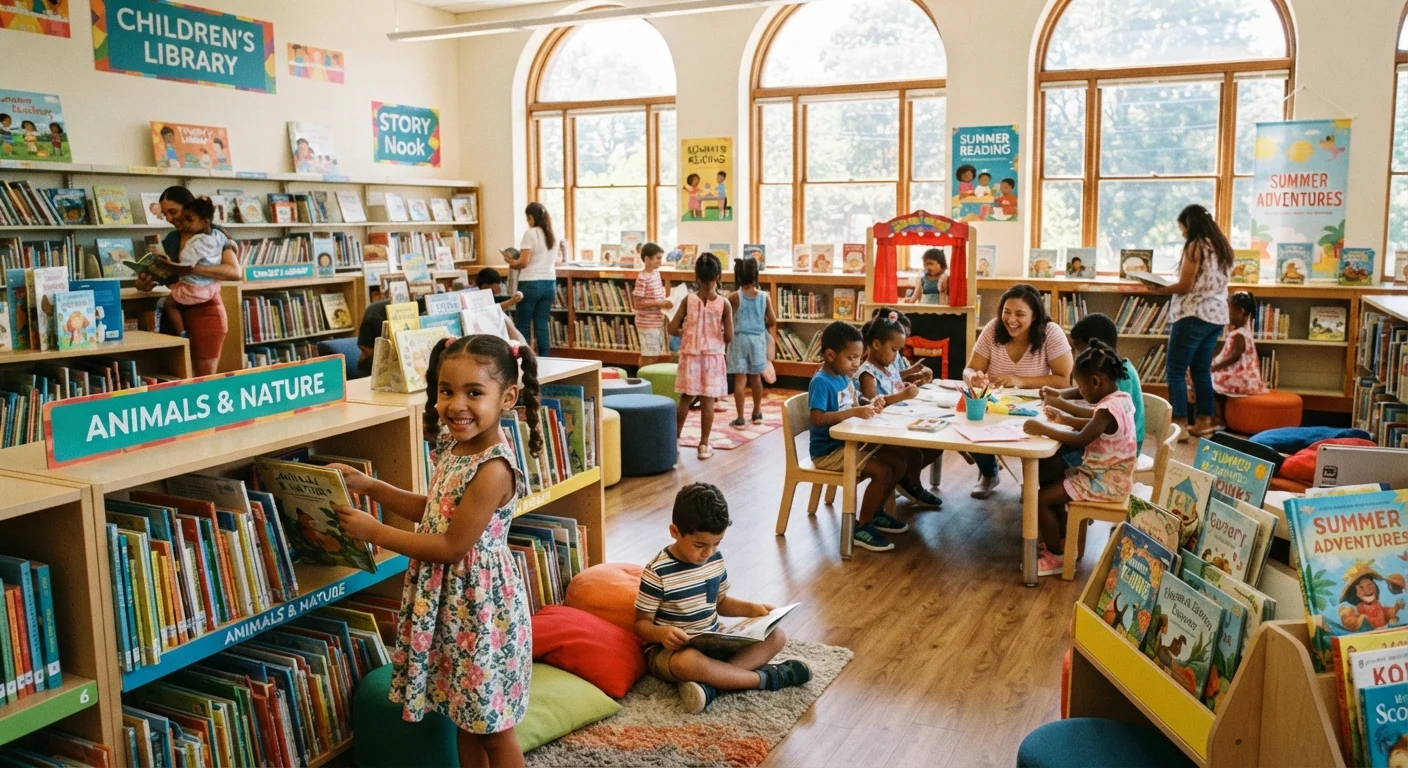
What summer library programs actually look like today
The image of a summer reading chart taped to the wall does not capture what most public libraries run today. Over the past decade, libraries have expanded summer programming into a full calendar of free events that can genuinely fill a family's week without spending anything.
A typical library system might run storytimes for toddlers three mornings a week, a maker-space workshop for school-age kids on Wednesdays, a teen creative writing group, and weekend performances open to all ages. Some branches bring in local scientists, authors, or musicians. Others partner with nearby cultural institutions: museum passes, zoo admission vouchers, and free movie screenings frequently appear as part of summer library partnerships.
The Collaborative Summer Library Program, a nonprofit consortium that most U.S. public library systems belong to, coordinates annual themes that libraries then adapt locally. One year might focus on oceans and science; another might center on music. The theme shapes crafts, book lists, and workshops, but the specifics depend entirely on what each library builds around it.
Summer library programs fit into a broader pattern of seasonal free activities that families can plan around throughout the year.
The range of programming beyond reading logs
Reading challenges are the anchor, but they are rarely the bulk of what is available. Here is what families commonly find when they look at a library's full summer calendar:
- STEM and maker activities: building challenges, basic coding, robotics kits, science experiments. Many libraries have dedicated maker spaces that open up additional programming slots in summer.
- Arts and performance: puppet shows, magicians, local theater groups, and visiting musicians perform free at branches. Some libraries run their own art workshops with supplies provided.
- Gardening and nature programs: seed-starting workshops, nature journaling, and guided outdoor walks appear at libraries with outdoor space or park partnerships.
- Film screenings: afternoon movie showings, often tied to the summer theme, give families an air-conditioned free option on hot days.
- Teen-specific programming: older kids often get their own track with different activities, volunteer hours, and social events so they are not grouped with younger children.
Check the calendar before school lets out
Many libraries open registration for summer workshops in April or May, before the school year ends. Popular STEM sessions and performer events fill fast. Pulling up your library's summer calendar in spring gives you the best shot at securing spots in the programs your kids most want to try.
Libraries in college towns sometimes draw on university faculty or student groups to run free workshops on topics like astronomy, environmental science, or world languages. Worth asking about even if it is not listed on the main calendar.
Museum passes and extended partnerships
One of the most underused benefits at many library systems is access to passes for local and regional cultural institutions. Through programs like the Culture Pass (available in New York State) or locally negotiated arrangements, cardholders can borrow passes that cover free or reduced admission to science centers, history museums, botanical gardens, and zoos.
These passes work like any other library item: you reserve them, check them out for a set period, and return them. Availability is limited, so families who want specific dates should plan ahead. The library's website or app usually shows real-time availability for pass reservations.
This kind of partnership illustrates why the true cost of a 'free' outing is worth thinking through. A museum pass through the library eliminates the admission cost, but parking or transportation to the museum still applies. Building that into the day's plan avoids surprises.
17,000+
Public library outlets across the U.S.
According to the American Library Association, the U.S. has more than 17,000 public library buildings and branches, giving most families geographic access to at least one location.
~5,000
Libraries using CSLP summer framework
The Collaborative Summer Library Program serves library systems in all 50 states, the District of Columbia, and U.S. territories, providing a common structure for summer reading initiatives.
Free
Cost of a standard library card for residents
Library cards are free to residents in virtually all U.S. public library systems, making summer programming accessible without any up-front cost.
How to find and use what your library has
The gap between what libraries offer and what families actually use often comes down to awareness. Programs are free, but they are not always loudly advertised outside the library itself.
The most direct approach is to visit the library's website and pull up the events calendar for June, July, and August. Most systems list programming by age group, making it easy to filter for what fits your household. If registration is required for a workshop, slots often fill in the first week or two after summer programming goes live, which for many systems is April or May.
Library staff at the children's or teen desk are a reliable resource. They know which programs tend to fill fast, which ones are drop-in, and whether any unadvertised partnerships or passes are available. A short conversation at the desk can surface options that do not appear on the website.
For families who want to layer in other free options alongside library programming, outdoor recreation spots that rarely get attention can round out a summer calendar without adding any cost. And for a longer view, federal fee-free days at national parks give families a way to plan at least one bigger outing each summer around a free admission window.
Frequently Asked Questions
Most libraries require a library card to participate, but getting one is free for residents. Some branches offer temporary cards for summer programs specifically. Check with your local branch about their sign-up process.
Most systems run separate tracks for babies and toddlers, early readers, school-age children, tweens, and teens. Many libraries also include adult and family programming. There is usually something for every age in a household.
Goals vary by library system and age group. Some programs track minutes read rather than book counts, which works well for reluctant readers or very young children. Many programs offer small incentives like stickers, prizes, or certificates for completing goals.
Most county and regional library systems extend programming to branch locations and sometimes to bookmobiles. Rural availability varies, but the CSLP framework is used by libraries in all 50 states. Contacting your local county library system directly gives the clearest picture of what is nearby.
You can often get a library card in any county where you work or attend school, in addition to where you live. Families sometimes participate in programs at multiple branches or systems, which can multiply the available events.
No. Modern summer library programs routinely include STEM activities, coding workshops, art projects, gardening, cooking demonstrations, musical performances, film screenings, and more. Reading challenges are one component, not the whole picture.
The content provided on our blog site traverses numerous categories, offering readers valuable and practical information. Readers can use the editorial team’s research and data to gain more insights into their topics of interest. However, they are requested not to treat the articles as conclusive. The website team cannot be held responsible for differences in data or inaccuracies found across other platforms. Please also note that the site might also miss out on various schemes and offers available that the readers may find more beneficial than the ones we cover.