

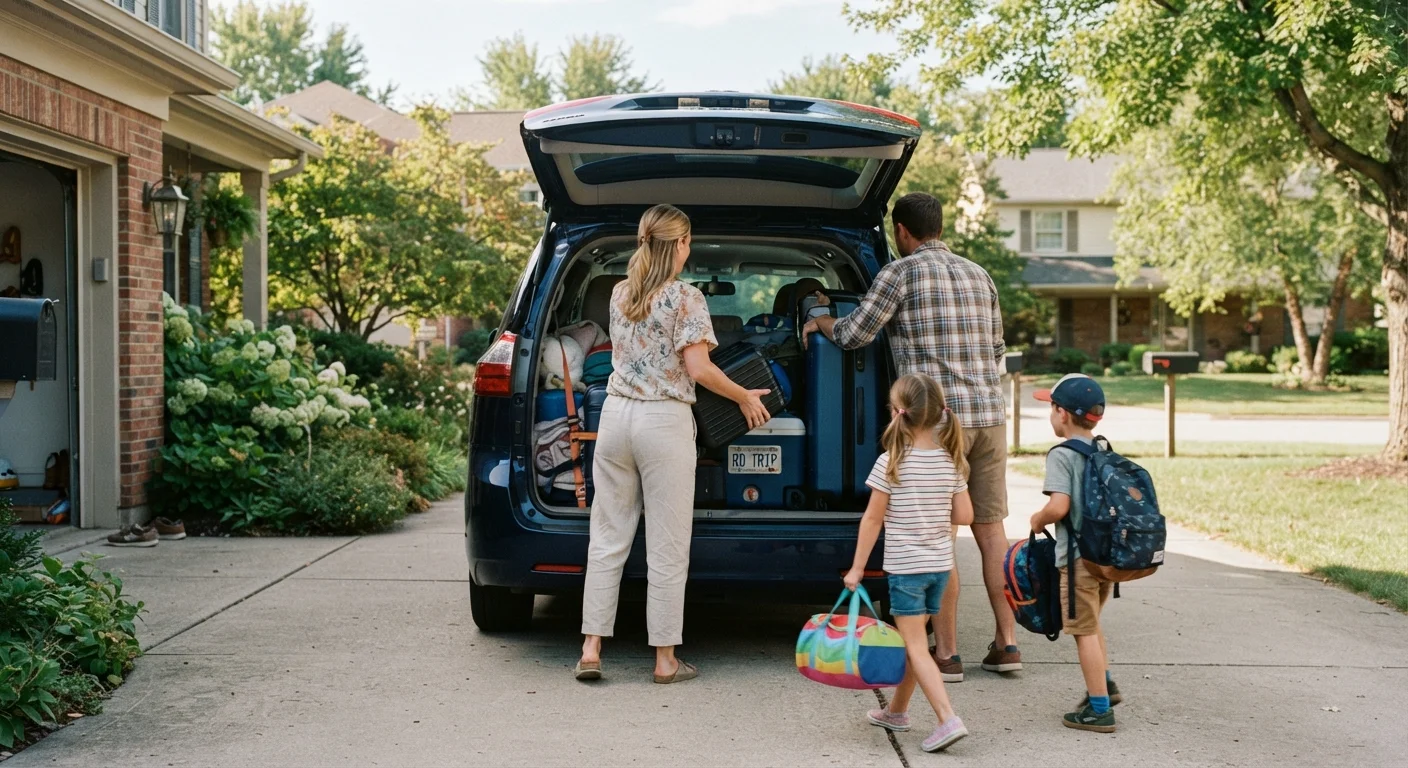
Option A
Road trip
The flexible, luggage-friendly overland option.
Best for: Families with young children, heavy gear, or destinations within a day's drive who want flexibility at each stop.
Option B
Flying with kids
The fast option for long distances.
Best for: Families traveling more than 600 miles who prioritize saving time over saving money on ground transport.
How to count the real cost of driving
Most families undercount road trip expenses by stopping at fuel and calling it done. The full ledger includes fuel, tolls, food purchased on the road, and any overnight stops required for longer routes. For a 700-mile drive, a family might stop once each way, adding two hotel nights to the trip cost before they have even reached the destination.
Fuel cost depends on your vehicle's fuel economy and current gas prices in the states you cross. A minivan averaging 22 miles per gallon on a 1,400-mile round trip (at roughly $3.50 per gallon) would use about 64 gallons, totaling around $224 in fuel. Add $30 to $60 in tolls on highway-heavy routes through states like New Jersey, Pennsylvania, or Illinois, and roadside meals for four people can easily add $80 to $120 per day of driving.
The advantage driving holds is that the cost does not scale with the number of passengers. A family of five pays the same in fuel as a family of three for the same trip. That per-person economics gap is where driving regularly beats flying for larger families. For further context on total trip budgeting, see the practical primer on affordable family travel.
| Criterion | Road trip | Flying with kids |
|---|---|---|
| Cost per passenger | Fixed (fuel/tolls split across all riders) | Per-seat ticket price per person |
| Luggage | No weight or bag limits in vehicle | Checked bag fees per bag, per flight |
| Travel time (800+ miles) | 10-16+ hours with stops | 2-4 hours in the air |
| Flexibility | Stop and change plans freely | Tied to departure times and booking |
| Car seat logistics | Use your own seat, already installed | Gate-check or pay rental fee at destination |
| Airport/parking costs | None | $15-$35/day or rideshare each way |
| Food costs en route | Roadside meals or packed food | Terminal meals at elevated prices |
| Best distance range | Under 500 miles | Over 700 miles |
The full cost of flying with kids
Airfare is priced per seat, which means a family of four buying four tickets is starting from a fundamentally different cost base than a solo traveler. A round-trip domestic ticket averaging $250 per person puts a family of four at $1,000 before any extras. Two checked bags add $35 to $40 each way per bag on most carriers, so two bags checked for a round trip adds roughly $140 to $160.
Airport parking runs $15 to $35 per day at most major airports. A four-day trip with five days of parking (day of departure through day of return) can add $75 to $175. Families who rely on rideshares instead pay $40 to $80 each way in many metro areas. Neither option is free.
There are also costs that do not appear on the booking page: meals inside the terminal, snacks for kids during the flight, and transport to the final destination if the airport is not close to where you are staying. These amounts are small individually but commonly add $50 to $100 per trip. Families sometimes discover more of these surprises after booking, which is why understanding why families overspend on vacation is worth reading before any booking decision.
Where the break-even point tends to fall
For a family of four traveling under 400 miles, driving is almost always the lower-cost option once airfare, fees, and airport logistics are counted. At 600 to 800 miles, the comparison tightens. At distances over 800 miles, flying often wins on total out-of-pocket cost when the family can avoid checked bags and find off-peak fares, though overnight stops can make driving uncompetitive at those distances anyway.
Family size moves the needle substantially. A family of two adults and one lap infant (if the child qualifies) may find flying cheaper. A family of two adults and three children who each need a seat changes the math entirely, because five tickets at any price quickly exceed the cost of fuel and tolls for most domestic routes.
Destination also matters. Families going to a city with a major airport close to their final stop face a different equation than those flying into an airport that requires a rental car on the other end. Renting a vehicle at the destination adds $50 to $100 per day and erases some of flying's cost advantage. It also raises the question of car seats, which rental companies charge extra for. For families already comparing accommodation costs at the destination, the hotel vs. vacation rental breakdown offers useful context on how lodging type intersects with travel mode.
One factor that rarely appears in cost calculators: the physical toll of a long drive on children and parents. An eight-hour drive with a toddler often means more stops, more food purchases, and sometimes an unplanned overnight stay. That variability can flip a road trip's apparent cost advantage. Families weighing these decisions can also check common myths about traveling cheap with kids to avoid assumptions that distort the math.
The content provided on our blog site traverses numerous categories, offering readers valuable and practical information. Readers can use the editorial team’s research and data to gain more insights into their topics of interest. However, they are requested not to treat the articles as conclusive. The website team cannot be held responsible for differences in data or inaccuracies found across other platforms. Please also note that the site might also miss out on various schemes and offers available that the readers may find more beneficial than the ones we cover.